
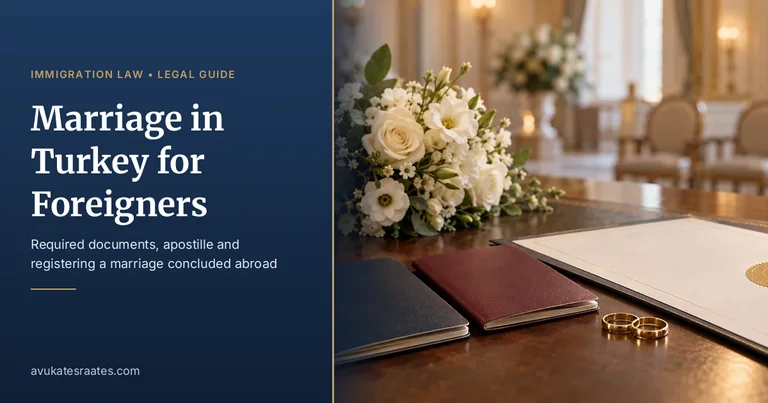

A foreigner can marry a Turkish citizen in Turkey only at a municipal marriage office or a civil registry office. They need a certificate of capacity to marry from their own country with an apostille or consular legalisation, a passport, notarised Turkish translations and a health report; the file is valid for 6 months from the certificate's date. A marriage abroad is reported to the Turkish consulate within 30 days. Marriage gives no residence: the spouse applies for a family residence permit.
Last updated: 8 October 2026. This guide is based on the current texts, as published on mevzuat.gov.tr, of the Evlendirme Yönetmeliği (Marriage Regulation) and the Nüfus Hizmetleri Uygulama Yönetmeliği (Regulation on the Implementation of Population Services), on Laws No. 5718, 5490, 4721, 6458 and 5901, and on official statements of the Nüfus ve Vatandaşlık İşleri Genel Müdürlüğü (NVİ, General Directorate of Population and Citizenship Affairs) and the Dışişleri Bakanlığı (Ministry of Foreign Affairs).
In Turkey, a Turkish citizen and a foreigner can marry only before a competent Turkish marriage officer; when one of the spouses is a foreigner, this authority belongs to municipal marriage offices (belediye evlendirme memurluğu) and to the heads of civil registry offices (nüfus müdürü) (5490 sayılı Nüfus Hizmetleri Kanunu [Population Services Law No. 5490] Art. 22/2; Marriage Regulation Art. 12). The foreigner's capacity to marry is governed by their own national law, and it is shown with an evlenme ehliyet belgesi (certificate of capacity to marry, often called a certificate of no impediment) issued by their own state and duly legalised (5718 sayılı Milletlerarası Özel Hukuk ve Usul Hukuku Hakkında Kanun [MÖHUK, Law No. 5718 on Private International Law and International Civil Procedure] Art. 13/1; Regulation Art. 20). The wedding alone does not give a residence permit or citizenship: the foreign spouse must also obtain an aile ikamet izni (family residence permit), and an application for citizenship requires a marriage of at least three years (Law No. 6458 on Foreigners and International Protection, Art. 34; Turkish Citizenship Law No. 5901, Art. 16).
Documents a foreigner needs to marry in Turkey
The foreign partner's file rests on four basic documents: a certificate of capacity to marry from their own country, a passport, a health report and photographs; to these is added the declaration form (beyanname) completed at the marriage office (Regulation Art. 18, Art. 20). For the Turkish citizen, a civil registry extract (nüfus kayıt örneği) takes the place of the certificate of capacity, and the office can obtain it from the system itself; the foreigner, by contrast, is as a rule expected to bring their own certificate (Art. 12, Art. 20).
| Document | Issued by | Legalisation and translation | Legal basis |
|---|---|---|---|
| Certificate of capacity to marry (evlenme ehliyet belgesi; also called a certificate of single status, bekârlık belgesi) | The central authorities of the foreigner's state or a mission of that state | Apostille, or consular and Ministry of Foreign Affairs legalisation; certified Turkish translation. A document from an honorary consulate (fahri konsolosluk) is not accepted. | Regulation Art. 12, Art. 20; MÖHUK Art. 13/1 |
| Passport or a document replacing a passport | The foreigner's state | The original at the application; the Ministry of Foreign Affairs and Istanbul municipalities also ask for a notarised Turkish translation | NVİ, Evlendirme Yönetmeliği Uygulaması (Implementation of the Marriage Regulation, 2017); Ministry of Foreign Affairs FAQ |
| Health report (sağlık raporu) | A public or private health institution | Without a report, the marriage cannot be performed | Regulation Art. 15/e, Art. 20 |
| Passport-size photographs | The parties | In colour, taken within the last six months; the number required varies from office to office | Regulation Art. 20 |
| Declaration form (beyanname) | The form at the marriage office | Signed by the parties or their representatives | Regulation Art. 18 |
| Certificate of capacity issued by the migration authority (stateless persons, refugees, conditional refugees, subsidiary protection, international protection applicants, temporary protection) | İl göç idaresi müdürlüğü (provincial directorate of migration management) | Replaces the home-country certificate | Regulation Art. 13 |
| Consent document or judge's permission (under 18) | Parent, guardian or court | Attached to the declaration form | Regulation Art. 14, Art. 20; TMK (Türk Medeni Kanunu, Turkish Civil Code) Art. 124, Art. 126 |
The certificate of capacity to marry must state the person's first name, surname, mother's and father's names, date of birth, and whether there is any impediment to their marriage (Art. 20). At the application, the officer compares this certificate with the passport and, on seeing any discrepancy that could cause the person to be confused with someone else, has the deficiency remedied (Art. 21). This is why it matters that first names and surnames are spelled identically in every document and every translation; the marriage page of Arnavutköy Belediyesi (Arnavutköy Municipality) in Istanbul states that applications are not processed when there is even a one-character difference. No proof of address is required from the foreigner; the address given in the declaration form is used (Art. 20).
Plan your timing around the certificate of capacity: the marriage file is valid for six months from the date the certificate was issued, and if the marriage is not performed within this period, the file is cancelled (Art. 42). There are two separate age thresholds. Under the Turkish Civil Code, a person who has not reached the age of seventeen cannot marry, and minors marry with the permission of their legal representative (TMK Art. 124, Art. 126; for the foreign partner, their own national law applies). To obtain a family residence permit after the marriage, however, each spouse must have reached the age of eighteen (6458 Art. 35/3-ç).
Apostille for marriage in Turkey: legalisation and translation
A foreign official document goes through two stages: first it is legalised in the country where it was issued, then it is translated into Turkish and the translation is certified. Which legalisation is enough depends on whether the issuing country is a party to the Yabancı Resmî Belgelerin Tasdiki Mecburiyetinin Kaldırılması Sözleşmesi (Convention Abolishing the Requirement of Legalisation for Foreign Public Documents) of 5 October 1961, known in Turkish as the Lahey Apostil Sözleşmesi (Hague Apostille Convention). The ratification of the Convention was approved by Law No. 3028, and the Convention entered into force for Turkey on 29 September 1985 (NVİ list of contracting states).
- If the country is a party to the Convention: The competent authority of the issuing country places a “tasdik şerhi” (Apostille) on the document. Under the Convention, this is the only formality that may be required to certify the authenticity of the signature, the capacity in which the signatory acted and the seal (Convention Art. 3-5). The Ministry of Foreign Affairs does not separately certify an apostilled document; it is submitted directly to the Turkish authorities.
- If the country is not a party and the document comes from that country: The document first goes through that country's internal legalisation chain and its ministry of foreign affairs, and is then certified by the Turkish embassy or consulate in that country.
- If the document is issued by the foreigner's consulate or embassy in Turkey: The mission's certification is legalised at the Ministry of Foreign Affairs if the mission is in Ankara, or at the valilik (governorship) of that city if it is in another city. In Istanbul, the Arnavutköy and Beyoğlu municipalities require a document obtained from a consulate in Istanbul to be certified at the kaymakamlık (district governorship).
The last two routes are each described in the official guidance of the Ministry of Foreign Affairs' Tasdik Birimi (Legalisation Unit). The translation is either certified at a Turkish mission abroad or made in Turkey by a sworn translator (yeminli tercüman) and certified by a notary (noter); the family residence permit document list of the Göç İdaresi Başkanlığı (Presidency of Migration Management) likewise requires both an apostille and a notarised Turkish translation for documents from abroad. If the officer doubts the authenticity of a document, they may have it verified through the Ministry of Foreign Affairs with the mission of the state concerned (Regulation Art. 20).
How to get married in Turkey: where to apply, step by step
The application starts with a declaration form that the couple submit together to a municipal marriage office or a civil registry office; if the file is complete, the officer sets the wedding date, and no public notice (ilan) has to be awaited before the marriage (Regulation Art. 16, Art. 21). The process runs as follows:
- Choose the office. TMK Art. 134 provides that the application is made to the marriage office of the place where one of the spouses lives; the NVİ frequently asked questions page, however, states that you can apply to any marriage office (except muhtarlık, the village headman's office) with no residence or address requirement. When one spouse is a foreigner, a village headman (köy muhtarı) and the müftülük (mufti's office) cannot perform the marriage; authority lies only with municipal marriage offices and the heads of civil registry offices (5490 Art. 22/2).
- Hand in the documents and sign the declaration form. The declaration form is completed on the basis of the Turkish partner's photo ID card and the foreigner's passport (NVİ, Implementation of the Marriage Regulation). The application steps can also be handled by a representative holding a special power of attorney (özel vekâletname); the power of attorney must clearly state the full identity of the person granting it, of the representative and of the person to be married, as well as its purpose (Art. 17).
- Review and setting the date. The officer compares the declaration form, the certificate of capacity and the identity document, has any deficiencies remedied, and notifies the wedding date and time according to the order of applications (Art. 21; TMK Art. 137). If the officer finds an impediment to the marriage, the application is refused in writing with reasons (Art. 23).
- The wedding ceremony. The parties attend in person with at least two witnesses; marriage by proxy is not possible (Art. 27). Witnesses must be adults with the capacity to discern who know the person they are witnessing for (Art. 28; TMK Art. 141). For a foreigner who does not speak Turkish, the officer may use an interpreter who knows the first official language of a state recognised by Turkey; the parties bring the interpreter before the ceremony (Art. 27).
- Family booklet and registration. As soon as the ceremony ends, the spouses receive an international family booklet (uluslararası aile cüzdanı); if the foreign spouse wishes, a multilingual marriage certificate (çok dilli evlenme belgesi) is also issued (TMK Art. 143; Regulation Art. 34). The duty to report the marriage to the civil registry office lies with the marriage office that performed it and must be fulfilled within ten days (5490 Art. 23/1; Regulation on the Implementation of Population Services Art. 22).
Can you marry in Turkey with an expired visa or residence permit?
The Marriage Regulation contains no provision requiring the foreigner to hold a visa or residence permit. However, in a letter sent to marriage offices in June 2024, NVİ asked that applications be accepted where the foreigner, together with a valid passport or a document replacing a passport, has a legal right to stay (yasal kalış hakkı) in Turkey. The letter was not published in the Resmî Gazete (Official Gazette); its content was quoted word for word in a written parliamentary question (yazılı soru önergesi) submitted to the TBMM (Türkiye Büyük Millet Meclisi, Grand National Assembly of Turkey) on 1 July 2024.
The marriage page of Arnavutköy Municipality in Istanbul points the same way: it requires the visa to cover both the application date and the wedding date and, if the visa has expired, asks for a visa extension or a residence permit document. No official information could be found that the letter had been withdrawn or amended as of 2026. The practical consequence is this: the application of a foreigner whose visa or visa-exemption period has ended and who has no residence permit may not be accepted; the foreigner's stay status must be regularised first. The options for a spouse in this situation are covered in the guide on the family residence permit for a foreign spouse in irregular status.
For people in Turkey under a status other than a residence permit, the Regulation provides a separate route. Applications from stateless persons, refugees, conditional refugees, persons with subsidiary protection status, international protection applicants and persons under temporary protection are accepted; their certificates of capacity are issued by the provincial directorate of migration management on the basis of the information in its own file, and the marriage notification is also made to the provincial directorate of migration management (Art. 13).
It is also possible to marry a foreigner who has been deported from Turkey. According to the Ministry of Foreign Affairs' answer to consular questions, the Turkish citizen declares in a notarised undertaking (noter taahhütnamesi) that they have invited the foreigner to marry and will cover their expenses in Turkey; the foreigner applies for a visa at a Turkish mission, their situation is investigated by the authorities in Turkey, and a visa is issued if this is found appropriate. The visa does not lift the entry ban; for the route that allows entry while the ban stays in place, see the page on the annotated visa (meşruhatlı vize).
How to register a marriage abroad in Turkey
A marriage that a Turkish citizen concludes abroad before a foreign authority is also valid in Turkey, provided that it complies with the Turkish Civil Code and that there is no ground for nullity (butlan); as to its form, the law of the country where the marriage took place applies (5490 Art. 24/1; MÖHUK Art. 13/2). The marriage is reported within thirty days at the latest from the date of marriage, by handing in or sending the document obtained from the foreign authority to the Turkish mission in that country. The Law places this duty on the husband or, if the husband is a foreigner, on the wife; the Regulation also states that where only one of the spouses is a Turkish citizen, that spouse makes the notification (5490 Art. 24/1; Marriage Regulation Art. 11).
Before marrying abroad, the Turkish citizen can obtain a multilingual certificate of capacity to marry, to be submitted to the foreign authority, from a civil registry office in Turkey or from a Turkish mission abroad (NVİ); at a mission, the couple make this application together and in person (Ministry of Foreign Affairs). Only two Turkish citizens can marry at a Turkish consulate; a Turkish citizen and a foreigner cannot marry at a consulate (Regulation Art. 10). After the wedding, registration works as follows:
- Get the marriage certificate. Ask the authority that performed the marriage for the marriage certificate and, if possible, its international (multilingual) version. A multilingual certificate issued under a convention to which Turkey is a party is accepted without any further formality (Regulation Art. 11).
- Apply to the Turkish mission within thirty days. According to the Ministry of Foreign Affairs' list, the foreign spouse's international birth certificate (Formül A), the original international marriage certificate, the originals of the spouses' identity cards and two photographs are required. The mission draws up the marriage notification and enters the marriage in the family register (aile kütüğü) through the system (Regulation on the Implementation of Population Services Art. 25/1).
- If you could not report it to the mission, go to a civil registry office in Turkey. The original of the duly legalised marriage certificate and its notarised Turkish translation are handed in to the civil registry office where you are (Art. 25/2). For this route, the Law requires the document to be certified by the Ministry of Foreign Affairs (5490 Art. 24/2); the Ministry does not separately certify an apostilled document.
- If you will apply to a mission in another country, check whether the country where the marriage took place is a party to Convention No. 16 of the Milletlerarası Ahvali Şahsiye Komisyonu (International Commission on Civil Status), the Çok Dilde Nüfus Kayıt Örnekleri Verilmesine İlişkin Sözleşme (Convention on the Issue of Multilingual Extracts from Civil-Status Records). For a marriage concluded in a contracting state, the application is accepted whatever the country; otherwise, the documents are sent for verification to the mission in the country where the marriage took place (Ministry of Foreign Affairs).
- Check the record. If the foreign spouse's identity details turn out to be incomplete or to contain an error caused by translation, ask NVİ for a correction, with a certified document obtained from the spouse's state and its notarised translation (Art. 25/4).
Missing the thirty days does not make the marriage invalid. The Yargıtay 2. Hukuk Dairesi (Court of Cassation, 2nd Civil Chamber) has stated that entering a marriage validly concluded abroad in the civil registry is an administrative act and does not affect the validity of the marriage (E. [docket no.] 2014/17373, K. [decision no.] 2014/22817, T. [date] 17.11.2014). 5490 Art. 68/1-b, which provided for an administrative fine of TL 50 for anyone who failed to report a marriage on time, was also repealed by Law No. 7039 in 2017. Even so, do not delay registration: until the record is made, the marriage does not appear in the Turkish spouse's civil registry record. The Göç İdaresi family residence permit document list mentions, for an applicant married to a Turkish citizen, a detailed civil registry extract (vukuatlı nüfus kayıt örneği) showing the spouse's details; and the Turkish spouse's civil registry extract also goes into a citizenship by marriage file (Türk Vatandaşlığı Kanununun Uygulanmasına İlişkin Yönetmelik [Regulation on the Implementation of the Turkish Citizenship Law] Art. 26/1-b).
Family residence permit for a foreign spouse after marriage
The foreign spouse of a Turkish citizen may be granted a family residence permit for periods not exceeding three years at a time; the permit does not arise automatically with the marriage but is granted on application (6458 Art. 34/1-a). The applicant spouse must live together, or intend to live together, with the Turkish spouse, the marriage must not have been concluded in order to obtain a family residence permit, and each spouse must have reached the age of eighteen (Art. 35/3). The document list, the income requirement and the appointment steps are explained in the guide on how to get a family residence permit; the table below only shows which route is open depending on the spouse's situation.
| The spouse's situation | Route to follow | Legal basis | More detail |
|---|---|---|---|
| In Turkey on a visa, a visa exemption or another residence permit | Apply to the governorship (e-İkamet) for a family residence permit before the permitted stay ends; if the period has been exceeded by no more than ten days, the application is still accepted | 6458 Art. 34; Uygulama Yönetmeliği (Implementing Regulation of Law No. 6458) Art. 19/3, Art. 21/2; Göç İdaresi document list | residence permit application receipt (ikamet izni müracaat belgesi) |
| Abroad | Apply for a family residence permit at the Turkish consulate in the country where they are; the Turkish spouse hands in the documents to the governorship of the place where they live; the application is decided within 90 days at the latest | 6458 Art. 21/1, Art. 21/5; Implementing Regulation Art. 32 | family residence permit |
| Has overstayed the visa or residence period | First regularise the stay status; the overstay is listed among the indicators that trigger a sham marriage investigation | Implementing Regulation Art. 21/2, Art. 34/1-ç | foreign spouse in irregular status |
| Subject to a valid deportation decision or entry ban | No family residence permit is granted; consider having the entry ban lifted or being allowed to enter while the ban stays in place | 6458 Art. 36/1-c, Art. 9/6 | annotated visa (meşruhatlı vize) |
| Married for at least three years and the marriage continues | Application for Turkish citizenship by marriage | 5901 Art. 16/1 | Turkish citizenship by marriage |
| Divorce | If the spouse has stayed on a family residence permit for at least three years, a short-term residence permit may be granted | 6458 Art. 34/6 | status of a foreigner divorced from a Turkish citizen |
Where there is reasonable doubt, the authorities investigate, before granting or renewing a family residence permit, whether the marriage was concluded solely to obtain a residence permit; where a marriage is found to be a sham (anlaşmalı evlilik), the permit is not granted, or is cancelled if already granted (6458 Art. 37). The interview and cancellation process is covered on the page on sham marriage suspicion and family residence permit cancellation; the route to follow against a refusal is covered in the guide on residence permit refusal.
Is there a family reunification visa for Turkey?
The Yabancılar ve Uluslararası Koruma Kanununun Uygulanmasına İlişkin Yönetmelik (Regulation on the Implementation of the Law on Foreigners and International Protection), which lists the types of visa, contains no separate type called a “family reunification visa” (aile birleşimi vizesi); family reunification is listed among the purposes of travel for “other visas” (Art. 11/1-f). Missions show the visa issued for this purpose separately in their own lists: for example, in its document list dated 22 January 2026, the Ministry of Foreign Affairs' Burgaz Başkonsolosluğu (Consulate General in Burgas) asks, for this visa, for a notarised undertaking from the relative who is a Turkish citizen, a document on kinship and marital status with a Turkish translation (a photocopy of the international family booklet if married to a Turkish citizen), and health insurance valid in Turkey for 90 days; missions may ask for additional documents. The visa allows a stay of at most 90 days in every 180 days (6458 Art. 11/1); a longer stay requires a family residence permit (Art. 19/1). A residence permit obtained from abroad becomes invalid if it is not used within six months (Art. 19/1).
Common misconceptions about marrying in Turkey
- “Once we marry, my spouse automatically gets residency.” A family residence permit is granted on application and only to someone who meets the requirements (6458 Art. 34/1). If the visa or exemption period ends without an application, the foreign spouse falls into irregular status; for the general rules, see the residence permit guide.
- “Anyone who marries a Turkish citizen becomes a citizen.” Marrying a Turkish citizen does not confer citizenship directly; a foreigner who has been married for at least three years and whose marriage continues may apply (5901 Art. 16/1).
- “We will marry at the mufti's office, or with a religious ceremony only.” If one of the spouses is a foreigner, only municipal marriage offices and the heads of civil registry offices are competent (5490 Art. 22/2). A religious ceremony does not replace the civil marriage; no religious ceremony may be held unless the family booklet is shown (TMK Art. 143).
- “If my foreign spouse cannot come, we will marry by proxy.” The application steps can be handled by a representative, but the marriage cannot be performed by proxy; both parties attend the ceremony in person (Regulation Art. 17, Art. 27).
- “A foreigner in irregular status can never marry,” or the opposite, “nobody asks about your stay status.” Both are incomplete. The Regulation sets no residence requirement and provides a separate procedure for people with protection status (Art. 13); but NVİ's 2024 letter makes the acceptance of the application conditional on a legal right to stay.
- “A marriage abroad is invalid if it is not registered in Turkey.” Registration is an administrative act and does not affect validity (Yargıtay 2nd Civil Chamber, E. 2014/17373, K. 2014/22817); but until the record is made, the marriage does not show up in procedures in Turkey.
- “You need a separate marriage visa to get married in Turkey.” There is no marriage visa among the visa types listed in the Implementing Regulation (Art. 11). What is required in practice is that the foreigner has a legal right to stay in Turkey when the application is accepted (NVİ's 2024 letter quoted in the TBMM question); some municipalities require this to cover the wedding date as well.
Legal basis and sources
- Evlendirme Yönetmeliği (Marriage Regulation; BKK [Council of Ministers Decision] 10.07.1985, 85/9747; Resmî Gazete [Official Gazette] 07.11.1985, No. 18921; last amended 28.11.2017, 2017/11079) Art. 10-18, Art. 20-23, Art. 27, Art. 28, Art. 34, Art. 42
- Nüfus Hizmetleri Uygulama Yönetmeliği (Regulation on the Implementation of Population Services; Official Gazette 09.05.2020, No. 31122) Art. 22, Art. 23, Art. 25, Art. 51
- 5490 sayılı Nüfus Hizmetleri Kanunu (Population Services Law No. 5490) Art. 22/2, Art. 23/1, Art. 24, Art. 68/1-b (repealed by Law No. 7039)
- 5718 sayılı Milletlerarası Özel Hukuk ve Usul Hukuku Hakkında Kanun (Law No. 5718 on Private International Law and International Civil Procedure) Art. 13
- 4721 sayılı Türk Medeni Kanunu (Turkish Civil Code No. 4721) Art. 124, Art. 126, Art. 132, Art. 134, Art. 137, Art. 138, Art. 141, Art. 143
- 4787 sayılı Aile Mahkemeleri Kanunu (Family Courts Law No. 4787) Art. 4
- 6458 sayılı Yabancılar ve Uluslararası Koruma Kanunu (Law No. 6458 on Foreigners and International Protection) Art. 9/6, Art. 11/1, Art. 19/1, Art. 21, Art. 34, Art. 35/3, Art. 36/1-c, Art. 37
- Yabancılar ve Uluslararası Koruma Kanununun Uygulanmasına İlişkin Yönetmelik (Regulation on the Implementation of the Law on Foreigners and International Protection) Art. 11/1-f, Art. 19/3, Art. 21/2, Art. 32, Art. 34/1-ç
- 5901 sayılı Türk Vatandaşlığı Kanunu (Turkish Citizenship Law No. 5901) Art. 16/1; Türk Vatandaşlığı Kanununun Uygulanmasına İlişkin Yönetmelik (Regulation on the Implementation of the Turkish Citizenship Law) Art. 26/1-b
- Yabancı Resmî Belgelerin Tasdiki Mecburiyetinin Kaldırılması Sözleşmesi (Convention Abolishing the Requirement of Legalisation for Foreign Public Documents; The Hague, 5.10.1961; Law No. 3028; Official Gazette 16.09.1984, No. 18517) Art. 3-5; NVİ: Apostil Sözleşmesine taraf ülkeler (states party to the Apostille Convention)
- Dışişleri Bakanlığı Tasdik Birimi bilgilendirmesi (guidance of the Ministry of Foreign Affairs Legalisation Unit)
- Dışişleri Bakanlığı Konsolosluk İşlemleri: Sıkça Sorulan Sorular (Ministry of Foreign Affairs, consular services: frequently asked questions); Burgaz Başkonsolosluğu vize belge listesi (22.01.2026) (Consulate General in Burgas, visa document list)
- NVİ: Evlenme İşlemleri (marriage procedures); NVİ: Nüfus Hizmetleri Sıkça Sorulan Sorular (population services: frequently asked questions); NVİ: Evlendirme Yönetmeliği Uygulaması (2017) (Implementation of the Marriage Regulation)
- Göç İdaresi Başkanlığı: Aile ikamet izni başvurularında istenen belgeler (Presidency of Migration Management: documents required for family residence permit applications)
- TBMM yazılı soru önergesi, 01.07.2024 (written parliamentary question quoting NVİ's letter to marriage offices)
- Supporting sources: Arnavutköy Belediyesi (İstanbul): Yabancı uyrukluların evlilik işlemleri (Arnavutköy Municipality, Istanbul: marriage procedures for foreign nationals); Beyoğlu Belediyesi (İstanbul): Evlilik işlemleri (Beyoğlu Municipality, Istanbul: marriage procedures)
- Yargıtay 2. Hukuk Dairesi (Court of Cassation, 2nd Civil Chamber), E. 2014/17373, K. 2014/22817, T. 17.11.2014
The information on this page is for general guidance only and does not constitute legal advice.
Frequently Asked Questions
Common questions on this topic
1 Can foreigners be witnesses at a wedding in Turkey?
Avukat Esra Ateş
Yes. According to the Ministry of Foreign Affairs' answer to consular questions, wedding witnesses may be foreign nationals, but they must know and understand Turkish. Under Article 28 of the Marriage Regulation, a witness must also be an adult with the capacity to discern who knows the person they are witnessing for.
2 Does the 300-day waiting period apply to a divorced foreign woman?
Avukat Esra Ateş
Under Article 132 of the Turkish Civil Code, a woman whose marriage has ended cannot remarry before 300 days have passed; the period ends with childbirth and can be lifted by a court. Article 23/2 of the Regulation on the Implementation of Population Services, however, provides that if the foreign woman's national law does not set a waiting period, the marriage office does not take this period into account.
3 What if my country does not issue a certificate of no impediment?
Avukat Esra Ateş
Under Article 12 of the Marriage Regulation, the rule is that the foreigner obtains the certificate personally from their own state's authorities; if that is not possible, the marriage officer may also request it through the NVİ General Directorate. For stateless persons, refugees and foreigners under international or temporary protection, the certificate of capacity is issued by the provincial directorate of migration management (Art. 13).
4 Is a marriage in Turkey recognised in my spouse's home country?
Avukat Esra Ateş
The Ministry of Foreign Affairs recommends submitting the marriage record extract (Formül B) obtained from the civil registry office to the authorities of the country concerned. Under Article 51 of the Regulation on the Implementation of Population Services, if this document is to be given to a country that is a party to the Hague Apostille Convention, the person concerned has the apostille added; in Turkey, governorships and district governorships are authorised to issue apostilles. Ask that country's authorities in advance how the document will be processed there.
5 Can we get married at my foreign partner's consulate in Turkey?
Avukat Esra Ateş
No. A Turkish citizen and a foreigner can marry in Turkey only before a competent Turkish marriage officer. Under Article 12 of the Marriage Regulation, only two foreigners who are both citizens of that state can marry at a foreign state's mission in Turkey, and only if their own laws allow it.
6 What can we do if the marriage office refuses our application?
Avukat Esra Ateş
The refusal is notified in writing with reasons (TMK Art. 137; Marriage Regulation Art. 23). Either spouse may apply to the court against the refusal; the objection is examined on the file and decided with a final ruling (TMK Art. 138). Because marriage is regulated in the family law book of the Turkish Civil Code, the competent court is the family court (4787 Art. 4); TMK Art. 138 sets no time limit for this objection.
For detailed information get in touch with us .


Comments (0)
Name
Awaiting approvalJust now
Comment text
Only you can see this comment. It will be public once approved.
No comments yet. Be the first to comment.